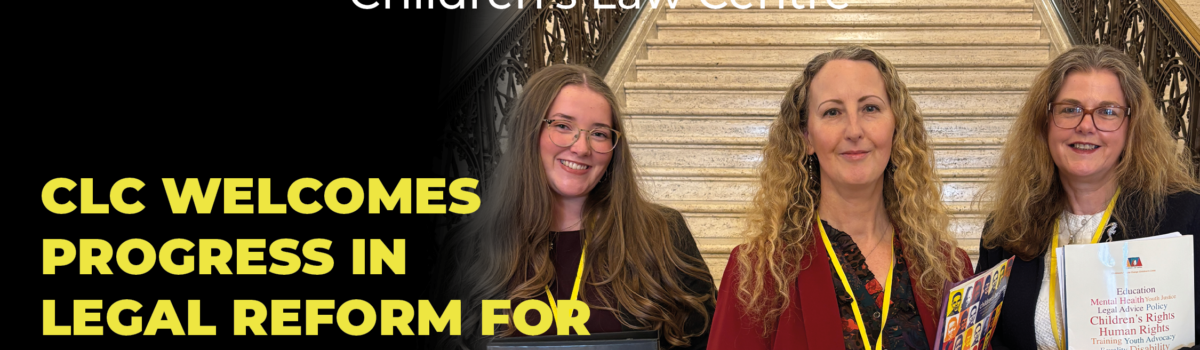
CLC Welcomes Progress in Legal Reform for Children with SEND

11 November 2026

The Children’s Law Centre (CLC) has welcomed vital work to amend significant reforms to the Special Educational Needs and Disability (SEND) framework. The work was commenced after CLC and a wide range of supporters intervened in April last year to highlight concerns to the Education Committee about the impact on children with SEND.

The Department for Education and CLC have since worked together on the legal framework to find a significantly improved way forward in setting the foundations for change. This work has secured key legal rights around the specification of provision in statements, recognition of the importance of health interventions which enable educational access and the central role of children and parents in making decisions about special educational provision.

Rachel Hogan BL, SEND Specialist Legal Adviser at CLC said: “Everyone recognises that children with special educational needs and disabilities face enormous barriers from within our education system. For many years we have witnessed the rights of children being infringed because they have not been getting the right support at the right time. 

“It is critical that changes to the SEND framework are effective in addressing those issues. That’s why we have worked constructively with the Department of Education to ensure that is the case.

“We are pleased that we have been provided with the time to support the work of the Department in securing and regulating the rights of children with SEND and that we have been able to reach an agreed way forward. Significant commitments have been made and assurances given by the Department on key areas around the identification, assessment and provision for children with SEND. These were some of the major concerns initially raised by CLC and others who signed our joint letter in April of this year.

“We also want to reassure parents that parental and child input into the assessment and statementing processes has been a focus of our work, making sure the voice of parents and children must be properly considered when decisions are being made. “CLC will continue to work with all interested parties to challenge any erosion of rights that may present, including through the finalisation of the Code of Practice and all of the underlying work of the EA in transforming SEND provision, including the development of Local Impact Teams and Enhanced Support Model which will change the way statements of SEND are written and how SEND provision is delivered.

An open letter was published by the Children’s Law Centre on 22nd April 2026 and endorsed by a broad coalition of trade unions, children’s charities and other organisations, calling for a halt to the implementation of new legal provisions through revised Regulations and a revised Code of Practice.

As part of the Education Committee’s scrutiny, the Regulations were paused to enable detailed technical work to ensure security of children’s legal rights. CLC has worked intensively with the Department on the content of the regulations and this joint engagement is now complete. The next step is for the Education Committee to decide whether it will recommend that the regulations proceed to the Assembly for approval and onwards to implementation.
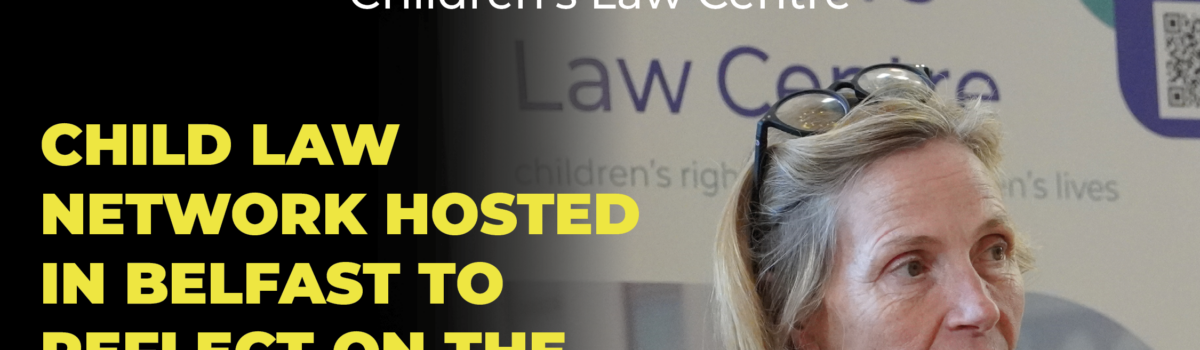
Child Law Network Hosted in Belfast

24th September 2026

For the first time, the Children’s Law Centre (CLC) hosted the Child Law Network in Belfast, bringing together children’s legal organisations, academics, practitioners and advocates from across the UK and Ireland to reflect on one of the most important questions facing children’s justice systems; when should a child become criminally responsible?

The event, ‘Childhood on Trial: Reflecting on the Age of Criminal Responsibility from Across the UK and Ireland’, was delivered by CLC on behalf of the Child Law Network, in partnership with the Centre for Children’s Rights at Queen’s University Belfast and the Ten is Too Young Coalition.

Efforts to raise the age of criminal responsibility is a long-standing global children’s rights issue, with UK and Ireland children’s organisations consistently calling for the age to be raised to improve outcomes for children in conflict with the law. Current ages across the UK and Ireland range from 10 to 12 years old, some of the lowest in the world.

A conversation Grounded in Evidence

The event was opened by Professor Bronagh Byrne, Director of the Centre for Children’s Rights at Queen’s University Belfast and John O’Doherty, Chief Executive of the Children’s Law Centre.

The first panel, chaired by Professor Byrne, considered the evidence for change, bringing together perspectives from criminology, forensic child and adolescent psychiatry and community practice.

Dr Mary-Louise Corr, Dr Phil Anderson, Dr Kate Laverty and Pete Wray explored the evidence behind calls for reform, including what we know about children’s development, the circumstances in which children come into contact with the justice system and approaches that can better respond to children’s needs.

Learnings from Other Jurisdictions

Fergal McFerran, CLC’s Policy and Public Affairs Manager, chaired a series of presentations and discussion exploring developments across the UK and Ireland.

Niamh McCormack of the Irish Penal Reform Trust provided a perspective from Ireland, where the age of criminal responsibility is generally 12, with exceptions for certain serious offences involving children aged 10 and 11. Ireland raised its age from seven to 12 in 2006.

Scotland provided another important point of comparison. Its age of criminal responsibility was raised from eight to 12 under the Age of Criminal Responsibility (Scotland) Act 2019, which was fully commenced in 2021. A Scottish Government review of the operation of the legislation was published in December 2025.

The event heard from Professor Lesley McAra and Alison Reid on Scotland, Shauneen Lambe of the Youth Justice Legal Centre on England, and Dr Rhian Croke of Children’s Legal Centre Wales. In England and Wales, the age remains 10.

The different experiences provided an opportunity to look beyond the question of the age itself and consider what happens when the law changes. What systems are needed to support children? What alternatives to criminalisation are available? What evidence can tell us about the impact of reform?

Northern Ireland: Majority Secured, Progress Failed

Northern Ireland recently debated whether to raise the age of criminal responsibility after decades of campaigning from leading children’s organisations.

Recommendations to raise the age had been included repeatedly in the UN Committee on the Rights of the Child’s concluding observations and then in the Youth Justice Review of 2011. In 2022, the Department of Justice consulted on a proposal to raise the MACR from 10 to 14, following a report ‘Tracing the Review: Developments in Youth Justice in Northern Ireland 2011-2021’ drafted by Dr Siobhán McAlister and Professor Nicola Carr.

In 2026, led by the Ten is Too Young Coalition, calls were renewed for the age to be raised to 16, without exceptions, as part of Northern Ireland’s justice bill. The bill provided a significant opportunity for change, with a number of amendments tabled during its consideration, including proposals to raise the age to 12, 14 and 16, with different approaches to exceptions.

While an amendment seeking to raise the age to 14 with some exceptions found majority support, a veto mechanism called the petition of concern was deployed to block any legislative change. The Ten is Too Young Coalition called the use of the veto an abuse of the mechanism.

Bringing the Conversation Together

The Child Law Network exists to strengthen collaboration between organisations working on children’s legal rights. Its members include leading children’s legal organisations from across the UK, working together to promote best practice, influence policy and law, identify opportunities for strategic litigation and develop cross jurisdictional learning.

CLC and the Centre for Children’s Rights at Queen’s University Belfast were delighted to host the network in Belfast. It provided an opportunity to bring different experiences together at a significant moment for children’s rights in Northern Ireland.

The event closed with reflections from Chris Quinn, the Northern Ireland Commissioner for Children and Young People.